
Open Knowledge Maps
Researchers looking for visual summaries of research topics; not ideal for those needing specific citation counts.
At a glance
3.8 out of 5
Scored by Alex after real useOur verdict
Open Knowledge Maps provides a visual overview and clusters papers into themes. However, it lacks specific citation metrics that some researchers require.
✓What it does well
✕Where it falls short
Key features
Questions about Open Knowledge Maps
What does Open Knowledge Maps do?
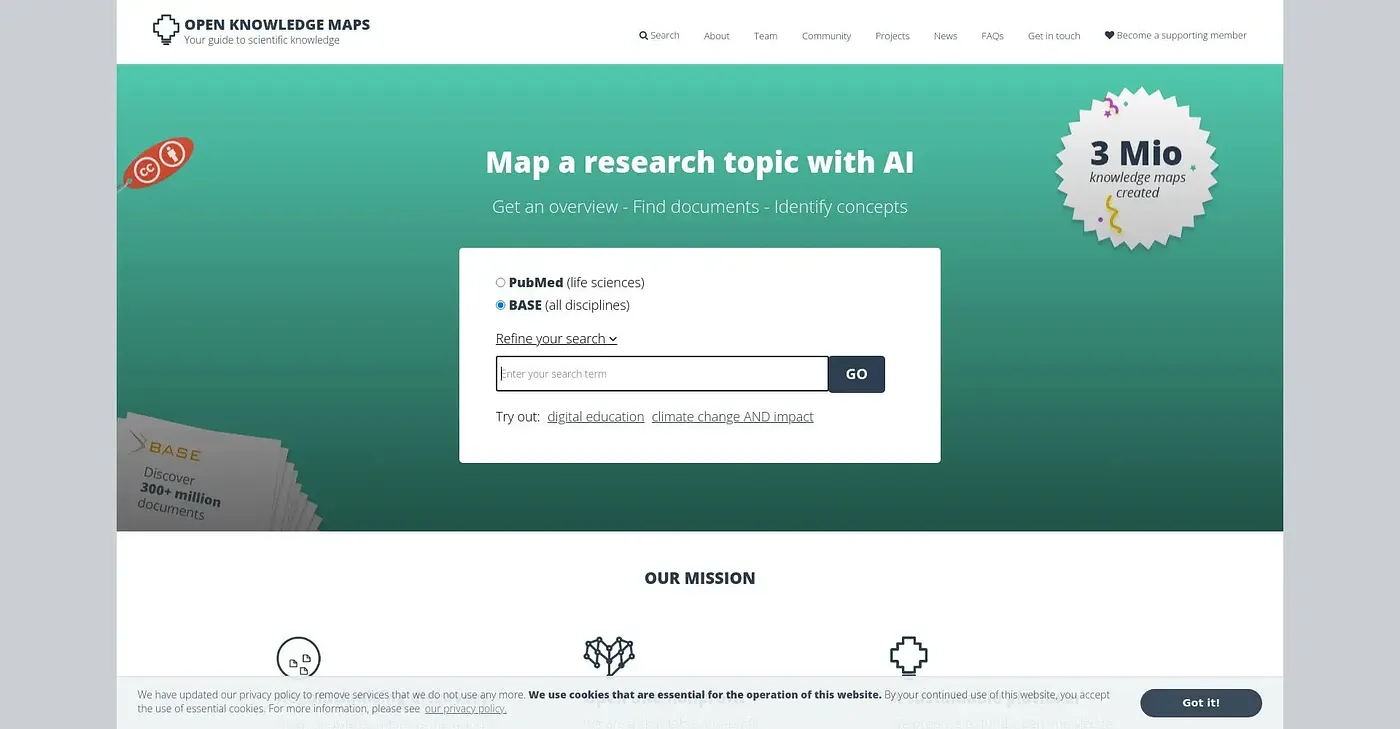
Open Knowledge Maps is an AI-based search engine that gives researchers a visual overview of a research topic. It organizes research outputs into thematic clusters for easier exploration and searches over 400 million outputs in more than 400 languages. It runs as a charitable nonprofit following open science principles.
How much does Open Knowledge Maps cost?
Open Knowledge Maps offers a Supporting Member plan at $39 per year, which includes access to advanced features, customization options and support for the platform's development. Toolio lists no free tier, and the reviewer notes the membership may be costly for individuals or small organizations.
Is Open Knowledge Maps open source?
Yes, Open Knowledge Maps is open-source software hosted on GitHub, so anyone can access and modify it. The organization runs as a nonprofit funded through supporting members, who contribute to the platform's development and sustainability.
Does Open Knowledge Maps show citation counts?
No. Open Knowledge Maps does not provide specific citation counts for research outputs, which the reviewer lists as its main gap for researchers who rely on those metrics. Custom integrations are available but require further discussion with the team.
Who is Open Knowledge Maps best for?
Open Knowledge Maps is best for researchers and scientists who want visual summaries of research topics. Toolio lists individual researchers on tight budgets as a poor fit, given the paid membership. It holds a Toolio score of 3.8 out of 5, scored by Alex after real use.