
Say Anything Prompt Segment Anything Model Chrome Extension
Adds natural language prompting to Meta's Segment Anything Model, though results are inconsistent.
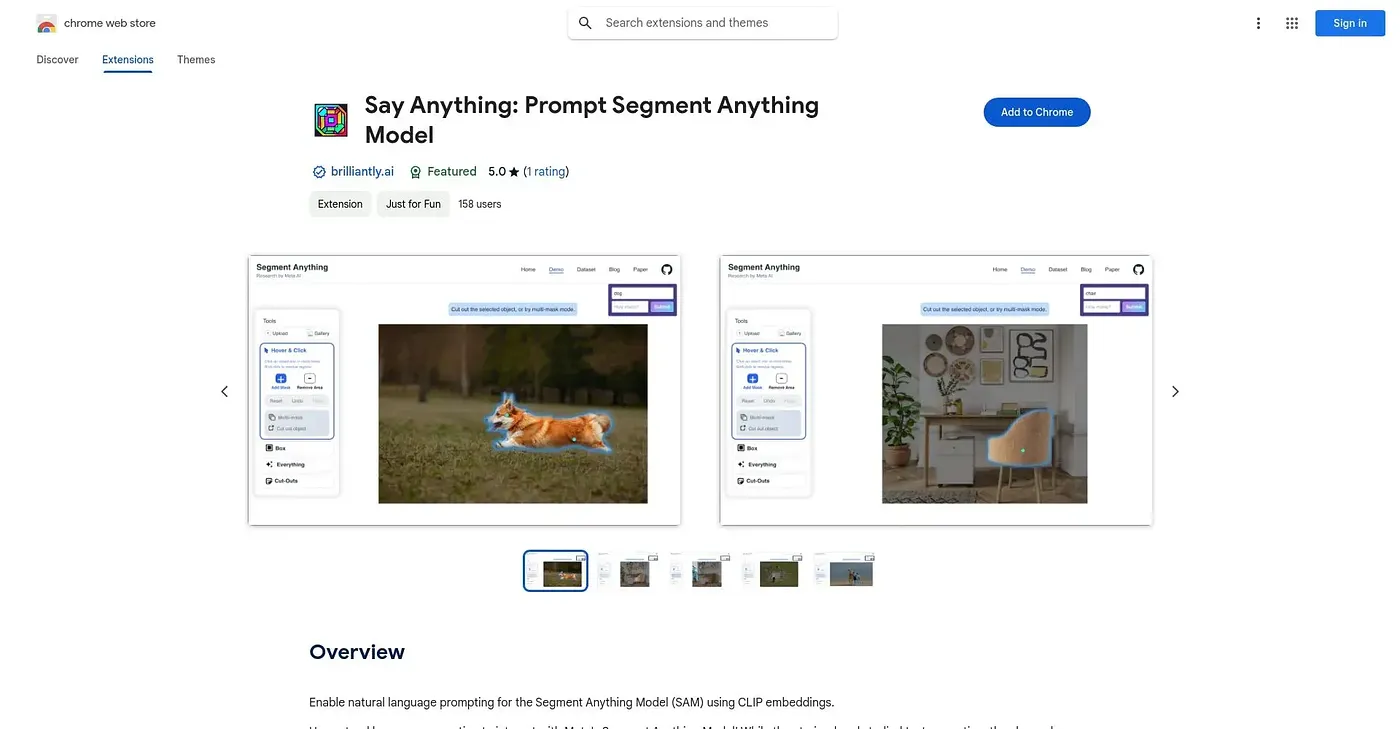
At a glance
Starts at
Free
No paid plan found on the Chrome Web Store, September 2026.
Free tier
Yes
Platforms
Chrome
Best for
Developers experimenting with text-prompted image segmentation
Not for
Anyone needing reliable, production-ready segmentation results
3.9 out of 5
Scored by Alex after real useOur verdict
This extension layers OpenAI's CLIP and gradient-based class activation mapping on top of Meta's Segment Anything Model, letting you describe what to select in plain language instead of clicking points. It's an independent, hobbyist project rather than an official Meta or OpenAI tool, built because the original text-prompting demo was never released publicly. Results vary noticeably in quality, and it requires setting up a separate backend server yourself before it works at all.
✓What it does well
Natural language selectionLets you describe what to segment instead of clicking points manually.
Built on open researchCombines OpenAI's CLIP with gradient-based mapping on top of SAM.
Open projectComes with an open backend repository you can inspect or modify.
✕Where it falls short
Inconsistent resultsSegmentation quality is inconsistent, with no guarantee a given result will be usable.
Requires backend setupDoes not function without a separate backend server set up locally first.
Experimental, not officialIs an unofficial hobby project, not something backed by Meta or OpenAI.
Key features
Text-prompted segmentationSelects image regions based on a typed natural language prompt.
CLIP-based encodingUses OpenAI's CLIP model to interpret prompts against image content.
Gradient-based mappingApplies gradient-weighted class activation mapping to locate relevant regions.
Local backendRuns against a backend server you set up on your own machine.