
Salad
Orchestrates AI workloads across global GPU pools.
At a glance
4.1 out of 5
Scored by Alex after real useOur verdict
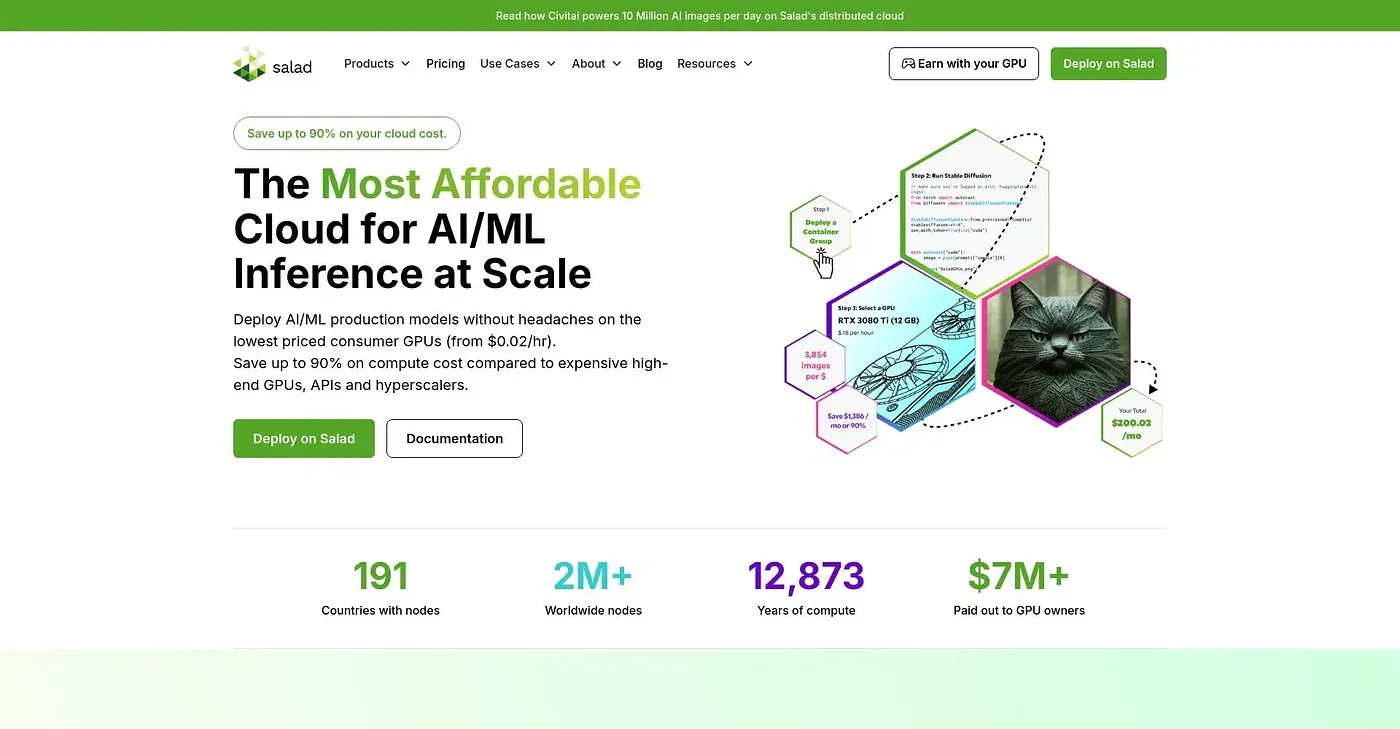
Saves up to 90% on AI compute. Best for distributed infrastructure but not hyperscaler services.
✓What it does well
✕Where it falls short
Key features
Questions about Salad
What is Salad used for?
Salad orchestrates AI workloads across global GPU pools, scheduling OCI containers onto distributed GPUs in thousands of locations worldwide. It supports both public clouds and community pools of idle GPUs, and it can reroute workloads to keep running if a node fails.
How much does Salad cost?
Salad starts at $0.015 per hour, as published by the vendor, and SaladCloud is charged per GPU-hour, billed per second. Salad Dedicated is priced on contact, and there is no free tier. The reviewer says Salad saves up to 90% on AI compute.
Can Salad run on on-premises GPUs?
No. Salad supports idle consumer hardware and cloud pools, not direct on-premises deployments, and Toolio lists it as not for on-premises data centers. The reviewer also notes it lacks specialized deployment options for large teams, unlike dedicated cloud providers.
What is live supply visibility in Salad?
Salad displays current availability and pricing for all GPU classes, a feature it calls live supply visibility. The reviewer lists it alongside the $0.015 per GPU-hour price as a strength. Salad also offers a Managed Token API that handles token-based billing for AI models.
Who is Salad best for?
Toolio lists Salad as best for developers and data scientists, and the reviewer says it suits distributed infrastructure rather than hyperscaler services. Toolio scores it 4.1 out of 5, scored by Alex after real use, and lists GpuX AI and Kypso among its alternatives.